Welcome to the blog of Martin and Margot Hodson! You can find out a lot about us by visiting our web site at www.hodsons.org We do not think we will use this blog very often, but we will use it to let people have details of some of our publications our speaking engagements and conferences. Some of these things seem better on a blog than on a web page, and this looks a bit easier to do as well.
Showing posts with label book. Show all posts

Wednesday, 18 December 2024

Martin and Margot Hodson, Christmas Letter 2024

Martin & Margot
Dear All,

Happy Christmas! We hope you are all doing well.

This year has been a bit of a momentous one for us. In May, after a year of preparations, we finally moved into our new house in Grove, Wantage. So after 23 years of living in vicarages, college accommodation etc. we are finally back in our own home. There is still quite a bit to do on it, particularly with the garden, but we are very happy.

The move has meant that Margot has stopped being on salary and is effectively freelance with our environmental work. Grove was where Margot had her curacy 20 odd years ago, and we have rejoined our old church. We still know lots of people, and have been made very welcome!  Margot has PTO (permission to officiate) and Martin has retained his authorised preacher status, which means we have taken a few services already in the benefice, and will do some over Christmas. But it is definitely not the same as every week.

Reunion at All Nations
Our work on the environment in the church continues to grow, particularly in theological colleges. We led a whole module on “Creation Care and Christian Mission” for All Nations Christian College in the first three months of the year, and invitations to teach in colleges continue to come in. We also went to a reunion for Margot’s year group at ANCC. It was wonderful to see everyone, including Margot’s old roommate. In the autumn we were out most weekends speaking at churches. We published a new Grove booklet, “The Ethics of Environmental Management”, which came out just in time for the COP meetings in the autumn. Earlier in the year Martin had the opportunity to interview one of his great heroes, Michael Mann, the American climate scientist, about his new book. Martin himself was interviewed by the Church Times (a slightly odd effort!).

Peter & Annie
Very unexpectedly, Martin’s research continues to take off! Four papers have appeared in international journals, the best for many years. Some work on carbon sequestration in phytoliths looks particularly promising and was picked up in a blog by Oxford Brookes (this was a better interview!).

We were pleased that American relatives, Greg & Pam and Peter & Annie were able to visit us during the year. Margot’s sister, Karen and her husband John housesat for our two-week holiday in September. We were very brave and took our electric car on the ferry from Portsmouth to St Malo for a stay in a nice gite in Brittany. Charging the car was easier than in England! Lots of nice walks and meals, and relaxing after the move. In the summer we held two big social events at our new house: a house blessing with our Sage friends from Oxford; and a day with almost all of Margot’s relatives.

Margot's Family

And so to 2025. Who would believe it is 2025 and we are a quarter of the way through the century? Our 2025 is shaping up to be more of the above. We hope yours is a good one, and that we see many of you at some point!

Martin and Margot


Tuesday, 21 December 2021

Martin and Margot’s Christmas Newsletter 2021


We don’t think any of us would have expected the Covid-19 pandemic to last this long! And it still seems to have a long way to go yet. Like everyone else, our 2021 has been affected in multiple ways by the pandemic. But we have managed to fit in a lot despite the problems caused.

Martin still divides his time between secular academic work and work with the churches on the environment. He has been teaching online for Oxford University and a new thing this year has been

acting as section editor for the international journal, Plant and Soil. Margot has been doing some teaching for Ripon College, Cuddesdon and we have both spoken at a number of conferences.

The work with the John Ray Initiative has been steadily increasing, and it was particularly busy around COP26. Our distance learning course Christian Rural and Environmental Studies (CRES) is now so popular that we had to pause admissions in June and we will reopen in January.

It was a good year for our joint publications. We wrote up a major report on environmental education in theological colleges, which seems to have had a big impact on greening a lot of colleges. The second edition of our book “A Christian Guide to Environmental Issues” appeared after a lot of updating. 

It was then taken up by “The Big Church Read”, (a Christian book club), and this involved making rather a lot of videos! At the same time, we brought out “Green Reflections”, a collection of our biblical reflections, illustrated with beautiful artwork from Martin Beek.

Margot’s boss, Harry, has not been well for some time, and things took a turn for the worse at Easter and he was signed off work. He has only just returned to light duties. So, for much of the year, Margot has been running our benefice of eleven churches on three days a week! 

We had a lot of help from the deanery and most things have run pretty well. Because of Covid-19 services have varied from online to outdoor to indoors and in person, all with an ever-changing set of regulations. Hopefully, things will improve again next year.

We seem to be able to grow fruit and vegetables! With our large and wonderful garden, we do seem to be relatively successful, even if constant battles against bugs and diseases seem par for the course with organic gardening. Holidays this year have been UK-based, and often short trips. The longest was a return to mid-Wales. We also had two trips to Herefordshire and one to Staffordshire. 

With many people heading for the coast we stayed inland! Lots of walks on all of our trips and two of them were fairly genealogical. In August we had a lovely family day, with Margot’s wider family – our first get-together for many months.

So, 2021 comes to a close. For us, not a bad year. Let us hope the global situation improves next year, and we can more easily see friends and relatives again (and not just on Zoom!)

Love from,

Martin and Margot

Sunday, 20 September 2020

Book Sale 2020!


The Good News

We are pleased to say that the first edition of “A Christian Guide to Environmental Issues”, published in 2015, has almost sold out, and we will have a new edition in 2021. Bible Reading Fellowship (BRF) have agreed to us publishing a completely updated second edition in the spring of 2021. At the same time, they will be publishing a collection of our Bible reflections on environmental issues to be titled “Green Reflections”. We are very grateful to BRF for this opportunity.


The Books Under The Bed!

The Not Such Good News

The first edition of “A Christian Guide to Environmental Issues” was selling really well. Martin sold 30 copies on a visit to Guernsey at the end of February, and we were easily on target to completely sell out of our personal copies. I think you can guess what happened! Lockdown and then a whole lot of restrictions which meant all our face to face events were canceled. Soon people discovered Zoom, but selling books at Zoom meetings was much less possible. So we are left with a stock of about 80 of the first edition under our bed! What to do?


The Potentially Good News

After consultation with BRF, we have decided to sell off our remaining stock at £3 each plus post and package (they are currently £8.19 on Amazon). They will be great for you to give away to friends at church or maybe as stocking fillers at Christmas. Contact us at martinjhodson@yahoo.co.uk to make an order.

Sunday, 26 August 2018

An Interview with Martin and Margot Hodson

In preparation for the publication of a series of reflections, “The Wisdom of Trees” in Bible Reflections for Older People (BRF, September-December 2018) the editor, Eley McAinsh, came to interview us. A shortened and edited version appears in the booklet, but here is the full version, also slightly edited.

Introduction: Margot
My name is Margot Hodson and I’m Rector of six churches in Buckinghamshire, quite near the Oxfordshire border. I’ve been involved in environmental things since I was a student. I went to university to study geography and to go into nature conversation. I had a call to Christian ministry there and the rest is history really, but I spend my time trying to combine the two.

Introduction: Martin
My name is Martin Hodson. I’m married to Margot and I’m a scientist, originally a plant scientist. I did a degree in botany and then a doctorate in plant physiology, but I’ve worked on environment and faith for round about 25 years. Now I’m the Operations Director with the John Ray Initiative, which is a charity looking at combining faith and the environment. I’m also the Principal Tutor of Christian Rural and Environmental Studies, which is a distance learning course based at Ripon College, Cuddesdon.

You’ve both written for BRF before and now you’re collaborating on a series for Bible Readings for Older People. Why did you decide to write about trees?
Margot: Trees are very important to the natural world – they’re whole little ecologies in their own right and lots of other things live on them. They’re important in the Bible – there are lots of places in the Bible where particular trees are mentioned and they also illustrate all sorts of spiritual truths. If you look at the way trees are used in the Bible you can find ways in which God is teaching us through them, so you can definitely learn from God through trees.
I’ve always loved trees and it was probably Dutch Elm Disease that really got me thinking about ecological problems back in the 1970s when I was at school. That’s something that has always stayed with me.
Martin: I actually wrote my first academic paper on trees, or a tree to be precise. It was a poor beech tree in mid-Wales that had a pile of salt dumped under it. Since then I’ve written a lot of scientific papers on trees.

Can you give me some examples of the ‘spiritual truths’ we can learn from trees?
Margot: We’ve written about the willow in Psalm 1, putting down deep roots to find water and putting roots deep down into faith; the almond tree in Jeremiah talks about ‘watching’; date palms are about ‘fruitfulness’ and the oak is about ‘righteousness’, so there are many different examples and we really can learn from them.
Martin: And I’ve just been writing about the mustard seed – is that a tree or not? – faith and the mustard seed.

On your various websites there’s quite a distinct division of labour: you, Martin, are the scientist and you’re the theologian Margot. But in reality, your work is much more closely integrated isn’t it? How has your collaboration evolved over the years?
Martin: As a scientist, obviously I specialize in the science, so when Margot and I work together, very often I will lead with the science. I’ll talk about climate change and other environmental issues, and then Margot will come in and talk about ethics and theology. But we both have enough knowledge of the other area to be able to both on our own. So, for example, on a recent trip to Sweden, I did whole lectures on theology as well as on the science and on what we can do, practically. I’ve had quite a lot of training in theology as well. I’ve done a lot of courses and I do a lot of reading on the subject. So we can switch around and we can take each other’s areas. But when we’re working together (as we did on ‘A Christian Guide to Environmental Issues’ (BRF, 2015)) I tend to write the first bit on the science and then Margot writes the theological reflection.
Margot: I came to committed Christian faith at university where I was studying in the geography department. We had a little Christian group which used to meet for lunch once a week and we talked about all sorts of things to do with global issues and tried to work out what the Bible, what the Christian faith, was saying about them. That was my foundation for thinking about both environmental questions and also theological and Christian responses. So although I’m more the theological lead these days, Martin has a lot of theological training behind him. Although he’s the science lead, I do have a science-based environmental degree, so we’re able to do each other’s thing. Occasionally if we’re doing something together we do the whole lot together, but usually Martin does the science and I do the theology.

So for both of you: how would you describe the way in which your faith drives and shapes your environmental work?
Martin and Margot with a copy of Bible Reflections for
Older People in Cornerstone Christian Centre, Grove
Martin: For me, of course, one of my main work roles is in the field of faith and environment. The John Ray Initiative is an organisation which was set up to look at the interaction between Christianity and the environment and environmental issues, so for me it’s a central part of my work. I do still do some secular work, teaching at Oxford University and at Oxford Brookes University, but a major part of my work is now directly to do with faith and the environment.
Margot: For me, my faith is very much informed by my understanding of the environment and my understanding of the environment is very much informed by my faith. It’s believing in God who is Creator, and who sees his creation as good. It is believing in the Holy Spirit who is Sustainer, and sustains this beautiful world that God has created. It is believing in Jesus who is Redeemer, who has redeemed the whole world through all that he did for us on the cross. We will one day see that redemption fully as we look towards a remade heaven and earth when all things will be renewed and creation will no longer be groaning, as it talks about in Romans 8. The leaves of the trees will be for the healing of the nations, as it talks about in Revelation 22. The idea that the whole Gospel is for the whole world, the whole universe, is something I find quite mind-blowing and that drives my understanding of nature. It also drives my understanding of the Gospel when I see the world that God has made.

So do you find that there are still arguments that have to be won in certain quarters?
Margot: Yes!
Martin: Very definitely!
Margot: We’ve just had the 500th anniversary of the Reformation and are now able to read the Bible for ourselves and find out about our faith. It’s so mind-blowing to know that it’s by God’s grace that we are saved; that it’s not of ourselves but it’s God initiative. He longs for people to know him and give their lives to him, but I think it’s been very easy for Christians over the years to miss a wider picture of God’s redemption and that sense that God had something for the whole universe. God so loved the cosmos that he gave his one and only Son that whoever believes in him… There is the sense that this is a much bigger thing than we ever imagined. But I think for many people that is such a new concept and for some people that can be quite a worrying concept. They might think it means that we don’t need to trust in God for ourselves any more, and what we do no longer matters if the whole world is going to be saved regardless. So what we’re saying is not that, but that in some sense God is going to renew and redeem the whole universe. It is something very big, and for some people it just seems too big. And in many places, the church is struggling with this. Something as new as that is hard for people to get their heads around.
 Martin: I’d agree with all of that. I think things have improved, and improved very markedly, certainly in the time I’ve been involved in this whole area. When I started about 25 years ago, we set up a small group in St Aldate's, Oxford – the St Aldate's Group for the Environment, which became ‘SAGE’ – there were real worries about this group. People feared we were going the wrong way and chucking out evangelism, and there were all those kinds of arguments. Actually, things have improved across large parts of the church. Then there was hardly anybody in the churches who would speak about the environment but now there are quite a lot of the bishops, for example, who are speaking up about the environment and it has become more mainstream. It’s not enough, but it is a lot better than it was, say, 25 years ago.

You both have experience working across a wide range of age groups – with students in universities and across the whole gamut of church life. Can you generalise at all about how the different generations are dealing with environmental issues?
Margot: I think it’s not as straightforward as some people might say. Some people seem to have this stereotype that older people are carbon-guzzling, lets-forget-about-the-planet dinosaurs and young people are deep green, vegan, carrot-eaters. And it’s not like that at all. It’s much more of a broad range across the board. Just as post-modernism affected all age groups, not just the young, I think all age groups have been affected by the things people see happening in the environment. In this country, and in mainland Europe, there’s grown a general understanding that there are environmental problems, that climate change is real, and there are challenges in the environmental area. All generations are responding to that, sometimes in different ways. For example, on diet, we came across this expression ‘flexitarian’ which means you don’t give up meat altogether but you reduce your consumption. That’s an easier approach for older people to adopt, whereas I’ve got a nephew who has gone vegan and is absolutely passionate about that. So people deal with it in different ways: again, there are a few, not many, younger people who were perhaps a bit overcooked on the environmental message as they were growing up. They had it every year at school, and they get to 18 and say just give me a fast car and a burger. People are people, and people respond in different ways, in different age groups and different socio-economic groups, but the general pattern in this country is towards increasing awareness. There’s huge variation but I don’t think it’s necessarily age-related, though I do think the younger generations will take many more things as read, so they’ll expect housing to be sustainable, for example, and expect cars to be greener, but in general it’s mixed right across the age range.
Martin: When I did ‘The Hope for Planet Earth’ tours with Tearfund and A Rocha UK some years ago they were largely with 16-year-olds. A lot of them were really committed, but there was also quite a lot of apathy, and sadly, there were some, as Margot says, who seem to have been ‘over-cooked’ and were just saying ‘we’re all going to die, it’s too late to do anything about it, so let’s just live and be merry and all that’. So in my experience, it isn’t as clear-cut as saying older people aren’t environmentally friendly and young people are. It’s doesn’t work like that.

More institutionally, what do you see going on at local church level, diocesan level?
Margot: I think in our churches we’ve had some really good goes at doing some green things. In our biggest church, St Mary’s, Haddenham, a few years back we needed to change the boiler and a group got together to look at sustainable options. We were really committed to a renewable energy option, but one by one each option fell by the wayside for a Grade 1 listed building. We wanted solar panels on the back of the church, the south side, which wouldn’t have been seen from the front but at that time the advice from the diocese was that we would not be given permission. It wasn’t even worth trying. I think that might be different now. We looked into a wood pellet boiler and that led us down a crazy road of potentially having to underpin the Grade 1 listed tower if we did it because we would have had to build an extra big boiler house. Eventually, we found a very, very efficient gas boiler, but we are thinking of trying again in the 2020s, and we might try again for solar power in the not-too-distant future because we’ve been told there has been a change of thinking on that.
We once had a great time when some of our secular friends thermal imaged the church on a very cold carol service night. It did show up the main problems, which are the windows because the building is medieval and you can’t put additional glazing onto medieval glass because it causes condensation and that damages the glass.
Martin: When we arrived here in Haddenham we thought we shouldn’t go too heavy on the green thing, because that’s what we were known for and the last thing you want is for the new vicar to bang on every week about the same topic – their favourite topic. But the write-up in the local Thame newspaper when we arrived had the headline ‘Green Vicar Appointed’ and within a couple of weeks we were contacted by this couple who said ‘We’re thinking about setting up a ‘Transition’ group in the village, can we come round and talk to you?’ We had a really good conversation and I think they were genuinely amazed that the church was interested. ‘Transition’ is a secular organisation which started down in the south-west. Totnes was the first but it’s now spread out from there and become international: it’s basically about making communities more sustainable. So they were wanting to start up a Transition group and we said ‘Yes, we’ll help you.’ They started by putting on showings of the film ‘The Age of Stupid’, the climate change disaster movie. When they realised I was a scientist got me to take the questions-and-answers after the showings. Because I’d been on these tours with Tearfund and A Rocha, basically nowadays people can fire almost anything they like at me and I can give them some kind of answer. Then after the film shows we did all kinds of things, like a campaign around the village with the thermal imaging camera.
Margot: We borrowed a camera first and then we got a grant to buy our own for the village.
Martin: Then we did something called ‘airtightness testing’, where you put a fan on the front door and you extract air out of the house. That produces a slight vacuum in the house and you can work out where all the drafts are.
Margot: We got a grant for that as well!
Martin: We’ve done lots on local food …
Margot: And the community orchard which has just had its official opening.
Martin: So all kinds of initiatives. It’s not all to do with the church, but as it happens, quite a few people from the church have been involved in Transition. We did have one event in the church when they had a bicycle-powered film so they had people cycling like mad to keep the power going.
Margot: They did it in relays…
Martin: So it’s all been very good in itself but it’s also been very good for church/community relations.
Margot: And one thing leads to another so we used the money we raised from ‘The Age of Stupid’ to buy an apple press and pressed all these apples, but at that point we hadn’t got the pasteuriser so the only thing we could do with the apple juice was inevitable: we made cider! When it came to the New Year’s Eve party they decided to have a cider competition and because I come from Somerset they thought I ought to be the judge – not because I was the vicar but because I came from Somerset. So I’ve been landed with this every year since: it’s a real ‘Vicar of Dibley role’ – I judge the village cider competition. It’s actually very good cider and for us it’s been a really nice way of making friends in the wider community.

In one of your publications, you explore the twin themes of interconnectedness and (eschatological) hope. I wonder how you would unpack those concepts, particularly for an older reader?
Margot: I think interconnectedness is something you recognise more as you get older. You realise more and more that everything is interconnected. You see the generations pass, the younger generations grow up and your connection to those generations and to the generations who have passed on or who are passing on. That sense of being part of a living planet is something that people become more and more aware of, simply through being part of their own families.
I started The Hope project with Ruth Valerio, a friend of mine, because at the beginning of the century we were both often brought in to be the platform speaker after a scientist. So the scientist would give the climate change Armageddon talk and then Ruth or I would be brought on to say ‘It’s alright, we have hope.’ Early on we felt that hope was about saying ‘It’s OK, we’ve got time to put things right. There’s still time to do something about climate change.’ But as time wore on, and particularly after the Copenhagen Agreement, which failed, we were less hopeful in the present and we each found ourselves moving more into the future and saying, ‘Don’t worry, Jesus will be coming back again. It’s all going to be alright.’ But that wasn’t a very realistic hope – it’s more of a fatalistic hope and it didn’t give hope to people when that was all you were offering. And yet I think for many older people that is the nature of their hope; they know that eventually they’ll be going to heaven, and that they’re a bit nearer to heaven than they may have been 30 years ago, but actually it doesn’t give them anything for the present. Somehow it paralyses them rather than resources them.
 So as Ruth and I worked on the project we brought people together to think about it and pray about it and we came up with the concept of what we called a ‘robust’ hope or a ‘resilient’ hope, which was a hope that gave us hope in the present because of that hope for the future. It is best summed up probably in Romans 5, where Paul says that suffering brings perseverance, perseverance character, and character hope. That sense of persevering, perhaps when things aren’t so easy, and that hope is there in the present and not just out there in the future, almost like a deposit, if you like, given to us through the spirit. It’s a concept that has given us a lot of hope in relation to environmental things, but I think it also offers hope to older people as they think through their lives because it has something for today, not just tomorrow.

Anything else either of you would like to add?
Margot: We have a U3A in the village and also some older clubs which are much more traditional, the kind of clubs that people in their 60s used to join. Things have changed enormously since those sort of clubs were set up and people in their 60s and 70s and even into their 80s are very much more active even than they used to be even a generation ago. They join cycling clubs rather than lunch clubs, and we joke that there’s probably a U3A whitewater rafting group. We’ve seen a huge change in the activity levels and energy levels of older people.
Martin: I’m on the U3A speaker circuit and I speak quite often to them. In Haddenham, there are so many people attached to U3A that there’s nowhere big enough to hold them all so they have to run all the meetings twice. The questions you get after a talk are always very sharp: thoughtful and well-informed.

Margot: And we hear similar stories from all over the area.

Wednesday, 20 September 2017

The Fourth Edition


The Four Editions!
I first arrived in Oxford Polytechnic (now Oxford Brookes University) in September 1989, and for the first few years I shared an office with ecologist, Peter Morris. I was hired to teach plant physiology, but I soon found myself teaching soils as well. Not long after I arrived, Peter started working on a new Master's course in Environmental Assessment and Management. This was to be a joint course with the Department of Planning, and I remember Peter had lots of meetings with Riki Therivel who was his joint course leader from Planning. In September 1990 the first cohort were recruited, and Peter, Riki and I all taught on the first day (28th September). I was involved in quite a bit of the course in the early days, but specialised in soils. Basically, what students needed to know were the likely impacts of developments on soils and how to mitigate them. The course was a great success. Fairly soon the idea for a textbook arose with chapters from many of those teaching on the course. Naturally, Peter and Riki were the co-editors, and they asked me to write the chapter on “Soils and Geology”. The first edition of “Methods of Environmental Impact Assessment” came out in 1995 (white cover) and my chapter was 18 pages long. The book seemed to fill a niche in the market, and soon there was talk of a second edition. Peter and Riki were keen to give the second edition a more applied feel and asked the authors to recruit some environmental impact assessment practitioners as co-authors. Peter recruited a friend of his, Roy Emberton, to help me with contaminated land issues. I recruited Chris Stapleton, a soils consultant who specialised in the assessment of agricultural land. Chris had taken a Planning course at Brookes including an option with my soils classes, and I asked him to come and teach with me (he still is!). So with such expertise available, I mainly concentrated on the more introductory soils material and on getting the whole chapter into shape, a role that I have continued to play in subsequent editions. The second edition was published in 2001 (blue cover), and the Hodson, Stapleton and Emberton chapter was now quite a lot longer (26 pages) and was entitled “Soils, Geology and Geomorphology.” Time moved on and I left the full-time staff at Oxford Brookes, but I continued to teach an annual soils session in tandem with Chris Stapleton for the Master's course. Chris and I were asked to take part in a third edition of the book. Roy Emberton moved to help Peter Morris with his Ecology chapter, so we needed someone to look after contaminated land issues. Chris found Kevin Hawkins of WSP Environmental, and we went to meet him in Reading. I suggested that Chris should be first author on the third edition, and I settled into the “senior author” position (last), which I felt was appropriate as my main role was one of coordination. In 2009 the third edition (brown cover) came out, including the Stapleton, Hawkins and Hodson chapter on “Soils, Geology and Geomorphology” (34 pages). Chris and I kept going with our annual session and whenever we met we wondered whether there would be a fourth edition. Then in 2015 we had the sad news that Peter Morris had died. I felt that would be the end of any hope for another edition. But Riki Therivel had other ideas and teamed up with Graham Wood in Built Environment to tackle quite an ambitious project. The publisher, Routledge, wanted the fourth edition to be rather different to the previous three. We had always concentrated on the UK and Europe, but now the book was to be international in scope. But no greater length than the third edition! This time Chris and I were joined by Hugh Masters-Williams of Jacobs UK who took on the contaminated land brief. Revising the chapter proved quite a challenge. I set it now in the context of the new Sustainable Development Goals (SDGs), and managed to include coverage of all the soil types in the world. And so the fourth edition (green cover) now sits on my coffee table. It has a somewhat expanded title: “Methods of Environmental and Social Impact Assessment”. The book is dated 2018 and is dedicated to Peter Morris. Without him there would have been no course and no book. The chapter on “Soils, Land and Geology” by Stapleton, Masters-Williams and Hodson is now 39 pages long, over double the length of my original 1995 effort. I would like to thank my co-authors, Chris, Roy, Kevin and Hugh for their contributions to the project over the years, and our editors Peter, Riki and Graham for their endless patience.
Now let's see. The average time between editions is about seven years. That makes 2024 for the fifth edition. Should just about be functional by then……

Martin Hodson

Sunday, 5 May 2013

Our Publications on Christianity and the Environment

Martin and Margot in Austria
Our Publications on Christianity and the Environment
For the past few years we have been writing and publishing quite a range of publications in the general area of "Christianity and the Environment". From the more academic to the more popular, and from books, booklets, and briefings to Bible studies and even a DVD! We thought it might be useful for people to have one spot which collects them all together and gives some details of how you can obtain each one if you want it (some are not easy to find!). We will arrange the publications by date:

2004
Margot started by linking her former work on the Jewish Roots of Christianity (e.g. A Feast of Seasons) with thinking about the environment:
Margot R. Hodson (2004) Environmental Christianity: insights from our Jewish Heritage. JRI Briefing Papers, No. 13, Cheltenham: The John Ray Initiative.
This briefing can be downloaded from the JRI web site and paper copies can be ordered from the JRI Office. A reasonable level of theological knowledge would be an advantage in reading this briefing.

2007
Margot was asked by Prof. Sam Berry to write a short epilogue article for his latest book:
Margot R. Hodson  (2007) Creative harmony: Isaiah’s vision of a sustainable future. in R. J. Berry, ed. When Enough is Enough, A Christian Framework for Environmental Sustainability. Leicester: IVP. p.169-177.
This book can be purchased from Amazon UK. A reasonable level of theological knowledge would be an advantage in reading this chapter.

In 2006 we both attended an important meeting at the International Baptist Theological Seminary (IBTS) in Prague where the aim was to consider what might go into the syllabus of a Bible College in terms of environmental theology.  John Weaver and Margot edited the resulting volume:
John Weaver and Margot R. Hodson eds. (2007) The Place of Environmental Theology: a guide for seminaries, colleges and universities. Oxford: Whitley Trust, & Prague: IBTS. The book can be downloaded HERE. Within this book Martin wrote a chapter:
Martin J. Hodson (2007) Environmental theology courses in Europe- Where are we now? in John Weaver and Margot R. Hodson eds. The Place of Environmental Theology: a guide for seminaries, colleges and universities. Oxford: Whitley Trust, & Prague: IBTS. pp. 107-120. Download HERE.
The book can be ordered from the JRI Office. The book is at a fairly academic level and would not be recommended for the general reader.

2008
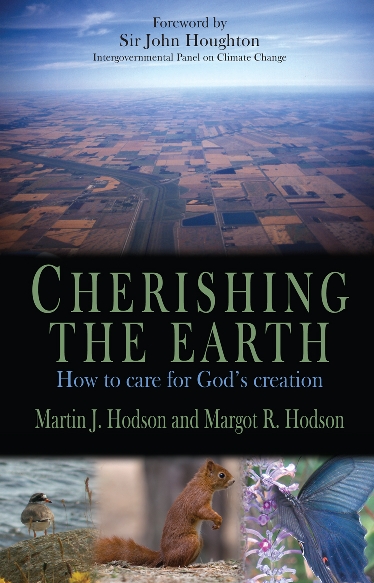
The pinnacle of our work so far in this whole area. Many years brewing, but worth it, was our book:
Martin J. Hodson and Margot R. Hodson (2008) Cherishing the Earth. How to care for God’s Creation. Oxford: Monarch.
The book can be ordered from the JRI Office, from Amazon (States) and Amazon UK  Intended for the general Christian reader. We gathered all the reviews we could find onto one page.

2009
Late in 2008 we both spoke at the annual Agricultural Christian Fellowship meeting. Margot gave the following paper which was written up for a Rusource Briefing:
Margot R. Hodson (2009) Theology of the Land. Rusource Briefing 776.
If you would like a copy of Margot's paper Contact Us.

In the spring of 2008 and 2009, Martin went on two national "Hope for Planet Earth" tours of the UK with JRI, A Rocha UK, Tearfund and SJI. We visited schools in the days and churches and Christian groups in the evenings, and covered a total of 35 towns and cities. Martin was the tour scientist and did all of the science presentations on the tours. As a spin-off from the tours we made two DVDs, one intended for churches (with Bible studies and theology) and one intended for schools (with lesson plans and ethics). Martin contributed the section on "The Problem", basically a brief look at the science of climate change.
Martin J. Hodson (2009) The Problem. In Hope for Planet Earth. A Christian Response to Climate Change. A multimedia DVD resource for churches. (eds E. Morrice & F. Moffat). SJI, London.
The DVDs can be ordered from the JRI Office. The Church DVD is intended for the general Christian public, and the schools DVD is aimed at 15/16 years and above.

2010
Margot was asked by the Oxford Centre for Mission Studies (OCMS) to write a chapter on environmental mission for their book on holistic mission:
Margot R. Hodson (2010) Storm clouds and mission: creation care and environmental crisis. in B.E, Woolnough and W. Ma eds. Holistic Mission. God's Plan for God's People. Oxford: Regnum Books International. pp. 212-226.
The book can be purchased from OCMS or downloaded for free HERE. If you would like a copy of Margot's paper Contact Us. Not a difficult read, but intended mostly for those interested in missiology.

2011
Margot studied geography for her first degree, and has has long had an interest in Isaiah. These factors came together in her Grove Booklet:
Margot R. Hodson (2011) Uncovering Isaiah’s Environmental Ethics. Grove Booklet, Ethics series, E161. Cambridge: Grove Publications.
More details about this booklet and how to get a copy can be found HERE. The booklet is set at a fairly high theological level.

Martin and Margot spoke at the big "Faith and the Future of the Countryside" in 2010, and this booklet came out of this work:
Martin J. Hodson and Margot R. Hodson  (2011) Climate Change, Faith and Rural Communities. Agriculture and Theology Project, Northampton.
The booklet can be ordered from the JRI Office or downloaded for free HERE. Not a difficult read, but note that it is very definitely focused on the rural areas of the United Kingdom.

2012
Martin helped supervise Lizzie Rushton's undergraduate thesis and the briefing arose from this work:
Elizabeth A.C. Rushton and Martin J. Hodson (2012) Faith, environmental values and understanding: a case study involving Church of England ordinands. JRI Briefing Papers No. 25, Cheltenham: The John Ray Initiative.
This briefing can be downloaded from the JRI web site and paper copies can be ordered from the JRI Office. This is more like a social science research paper, and has quite a lot of statistical analysis. But you can avoid all that if you wish to get an idea of the overall conclusions! Obviously set in a UK context.

2013
Margot was asked by Bible Reading Fellowship (BRF) to contribute 12 Bible Studies on the Environment and Bible for their booklet covering the early part of 2013:
Margot R. Hodson (2013) Environment and the Bible. in L.Cherrett ed. Guidelines, Bible study for today’s ministry and mission, Vol 29 part 1.
Fortunately, BRF decided to release Margot's studies as a FREE SAMPLE in PDF format. If that does not work Contact Us. These studies are intended as an introductory set  for people who are new to thinking about this area, but could be a valuable resource for anyone.

Our friends from Redcliffe College, Gloucester, UK asked if we would write a chapter for them on Climate Justice, and this was the result:
Martin J. Hodson and Margot R. Hodson (2013) Climate Justice: contemporary developments in science, policy, action and theology. In Carnival Kingdom - biblical justice for global communities. Eds. M. Hoek, J. Ingleby, C. Kingston-Smith, & A. Kingston-Smith. 125-143. Wide Margin Publishers.
Our chapter can be downloaded for free and details of how to order the whole book are HERE.The book is intended for those interested in mission/justice, but our chapter has a useful summary of the science and policy on climate change up to August 2012, which may have wider use.


Margot started a project on "Environment and Hope" with Ruth Valerio in 2010. This led to a small consultation and then a larger conference. After the conference we were approached by Anvil theological journal, who asked if we could produce a special edition on the topic. So in September 2013 the edition we co-edited appeared HERE. This is written at a fairly academic level.
Margot wrote an editorial for the volume: Margot R. Hodson (2013) Discovering a robust hope for life on a fragile planet. Anvil 29(1), 1-6. Free download HERE
Martin also had a paper in the journal looking at our current environmental situation, that was the "setup" paper for the following papers on theology and action: Martin J. Hodson (2013) Losing hope? The environmental crisis today. Anvil 29(1), 7-23. Free download HERE.

2014
Sierra Nevada, Spain
On paper this was not quite as productive as in some previous years, but we had a three month sabbatical from August to October (mostly in Spain and Portugal), and the fruits of that will be apparent in 2015. However, we did produce a few short blog articles which appeared in 2014.
Martin wrote several posts for the John Ray Initiative blog:
1) Genetically Modified Animals HERE
2) Meat, Climate Change and all that HERE
3) Review of "The Collapse of Western Civilization": Naomi Oreskes and Eric M. Conway HERE

Margot was asked by Christian Concern for One World to write an article for them:
Margot R. Hodson (2014) Why I Care about the Environment. Download HERE.

2015
In the last few years there has been a growing campaign suggesting that institutions should get rid of their investments in fossil fuels. This started in the States, but has spread worldwide. Many churches and denominations have divested, but some have still to decide (notably the Church of England). Operation Noah have led the campaign in the United Kingdom for churches to divest. We were very pleased to be asked to contribute a short article on the ethics of divestment to join a distinguished group of authors looking at this topic. Links to the articles coming out of this can be found HERE. Our own article is: Martin J. Hodson and Margot R. Hodson (2015) Is it ethical to invest in fossil fuels? How can environmental ethics inform our decision making? HERE


Margot was asked to write an article for Preach Magazine which was producing a special edition on "Preaching for the Planet" in Spring 2015. The whole magazine is HERE.
Margot's contribution is: Margot R. Hodson (2015) Preaching for the planet- key Bible passages. Preach Magazine (Spring 2015), 20-24. HERE

Martin was asked to review Michael Northcott's "A Political Theology of Climate Change" for Anvil Journal (March 2015), and the result is on p. 76 of the book reviews section. HERE

We had been working on the whole area of climate scepticism really since the Copenhagen climate change conference in 2009. But we finally managed to finish off the work on our 2014 sabbatical and here it is:
Martin J. Hodson and Margot R. Hodson (2015) The Ethics of Climatic Scepticism. Grove Books Ltd., Cambridge.
Details of the contents, where you can purchase a copy, and the formats that it is available in are HERE.

Coming in September 2015: "A Christian Guide to Environmental Issues".


Saturday, 13 April 2013

Functional Biology of Plants- One Year On


One Year On


It is one year today (13 Apr 2012) since the official publication date of Functional Biology of Plants by Martin J. Hodson and John A. Bryant. What has happened concerning our book in that time? Quite a lot actually!
John had published several textbooks before, but this was a new experience for Martin, and we both had no idea how the book would be received, and what would happen to it. We are now in a digital age, and Functional Biology of Plants was available on Kindle and other electronic formats as well as in the traditional hardback and paperback versions. But as we will see a lot of the publicity and marketing for the book has been through various on-line means. But before then:

Celebration

We were fortunate to have two opportunities to celebrate the publication of our book within the first few months of it coming out. First Martin met with John Bryant when they both attended the same conference in May 2012 (bottom middle photo in the collage above). Then another little celebration! This time in Oxford at Cafe Noir for a nice meal in the company of David Evans (Head of the Department of Biological and Medical Sciences at Oxford Brookes University) and Rachel Wade from Wiley-Blackwell (who took the photo: l. to r. Martin Hodson, David Evans and John Bryant).

The Facebook Page

Martin had quite a bit of experience running various Facebook pages, and this seemed an ideal time to try it out with our book. As far as we know nobody has seriously tried to market a Plant Science textbook, or indeed any other textbook, using Facebook before. We set up the page on 1st March 2012, over a month before the publication date. Martin and John invested a little in marketing the page, and we soon started to gain interest. Our publishers, Wiley-Blackwell saw that it was working and generously added to the overall marketing pot. The page grew and grew, and is now heading towards 5,000 likes, many of which are from India. John and I regularly update the page with photos, stories and the latest from the world of plant science. If you have not visited the page go HERE.

 Reviews

 So far reviews have come from three sources:
1) Amazon UK have published eight reviews. These have been excellent with seven 5 star and only one 4 star. The latter was really wanting a gardening book, so it is not surprising he felt he needed a brain transplant after reading our book! There was also one further 5 star review in Amazon Japan. Unfortunately, none of the UK or Japanese reviews have translated across to Amazon in the USA.
2) The review with the biggest impact was by Choice who selected our book for their award list: “Students who are new to plant science will be quite well served, as will graduate students and others needing to develop fuller understandings and perspectives on their research.” – Choice, 1 November 2012. This prestigious list contains approximately 10% of the 7,000 titles reviewed by Choice in a year. Ours was one of 24 Wiley titles selected.
3) Reviews in academic journals have been predictably slower, and so far we only know of one. "Martin Hodson and John Bryant have written the most captivating and elementary textbook on modern plant biology. It might be read from cover to cover by anyone seeking an introduction to the subject, but seems especially suited to high school, undergraduate and vocational courses." Philip White  in Experimental Agriculture. 
So as good as it can get!

Old Gang mine in Swaledale in North Yorkshire, UK.
Other Good Publicity

In addition to the above our book has had some other good publicity during the past year.
Before we were even published there was a short note in AoB Blog.
Dr Anne Osterrieder has been a good friend of our book. She mentioned our Facebook Page (see above) as an example of good practice in using Facebook in her talk (slide 13) on enhancing the on line presence of scientists at the SEB meeting in Salzburg, Austria. She also interviewed both Martin Hodson and John Bryant for her blog, giving good plugs for the book along the way.
Martin was asked to write a review for The Biochemist Magazine on "Metal toxicity and tolerance in plants" and the editor kindly suggested a small plug (and photo of the book cover) within the article.

NEXT YEAR- watch this space!


Saturday, 23 March 2013

Carnival Kingdom

Carnival Kingdom - biblical justice for global communities
Edited by Marijke Hoek, Jonathan Ingleby, 
Carol Kingston-Smith, and Andy Kingston-Smith.
We were pleased to contribute the Climate Justice chapter to this (2013) book:
HODSON, M.J. & HODSON, M.R. (2013) Climate Justice: contemporary developments in science, policy, action and theology. In Carnival Kingdom - biblical justice for global communities. Eds. M. Hoek, J. Ingleby, C. Kingston-Smith, & A. Kingston-Smith. 125-143. Wide Margin Publishers.

For more details go to Carnival Kingdom