Welcome to the blog of Martin and Margot Hodson! You can find out a lot about us by visiting our web site at www.hodsons.org We do not think we will use this blog very often, but we will use it to let people have details of some of our publications our speaking engagements and conferences. Some of these things seem better on a blog than on a web page, and this looks a bit easier to do as well.
Showing posts with label climate change. Show all posts

Wednesday, 18 December 2024

Martin and Margot Hodson, Christmas Letter 2024

Martin & Margot
Dear All,

Happy Christmas! We hope you are all doing well.

This year has been a bit of a momentous one for us. In May, after a year of preparations, we finally moved into our new house in Grove, Wantage. So after 23 years of living in vicarages, college accommodation etc. we are finally back in our own home. There is still quite a bit to do on it, particularly with the garden, but we are very happy.

The move has meant that Margot has stopped being on salary and is effectively freelance with our environmental work. Grove was where Margot had her curacy 20 odd years ago, and we have rejoined our old church. We still know lots of people, and have been made very welcome!  Margot has PTO (permission to officiate) and Martin has retained his authorised preacher status, which means we have taken a few services already in the benefice, and will do some over Christmas. But it is definitely not the same as every week.

Reunion at All Nations
Our work on the environment in the church continues to grow, particularly in theological colleges. We led a whole module on “Creation Care and Christian Mission” for All Nations Christian College in the first three months of the year, and invitations to teach in colleges continue to come in. We also went to a reunion for Margot’s year group at ANCC. It was wonderful to see everyone, including Margot’s old roommate. In the autumn we were out most weekends speaking at churches. We published a new Grove booklet, “The Ethics of Environmental Management”, which came out just in time for the COP meetings in the autumn. Earlier in the year Martin had the opportunity to interview one of his great heroes, Michael Mann, the American climate scientist, about his new book. Martin himself was interviewed by the Church Times (a slightly odd effort!).

Peter & Annie
Very unexpectedly, Martin’s research continues to take off! Four papers have appeared in international journals, the best for many years. Some work on carbon sequestration in phytoliths looks particularly promising and was picked up in a blog by Oxford Brookes (this was a better interview!).

We were pleased that American relatives, Greg & Pam and Peter & Annie were able to visit us during the year. Margot’s sister, Karen and her husband John housesat for our two-week holiday in September. We were very brave and took our electric car on the ferry from Portsmouth to St Malo for a stay in a nice gite in Brittany. Charging the car was easier than in England! Lots of nice walks and meals, and relaxing after the move. In the summer we held two big social events at our new house: a house blessing with our Sage friends from Oxford; and a day with almost all of Margot’s relatives.

Margot's Family

And so to 2025. Who would believe it is 2025 and we are a quarter of the way through the century? Our 2025 is shaping up to be more of the above. We hope yours is a good one, and that we see many of you at some point!

Martin and Margot


Saturday, 22 June 2019

Can Phytoliths Save the World?


Can Phytoliths Save the World?
Or: Plants do Carbon Capture and Storage Quite Naturally

Can Phytoliths….. Can what?? Many people have never heard of phytoliths, but I have worked on them for nearly 40 years, so let me tell you a little about them, and then I will describe some of my recent research. Yes, these unheard of phytoliths might help in the fight against climate change. But read on.
Pampas grass
Have you ever cut your hand pulling up grass? Have you noticed how sharp the edges of Pampas grass are? Have you ever been stung by a stinging nettle? This is all due to phytoliths! Soluble silica is taken up by the plants and is deposited in some of the cells as hard, solid phytoliths. If you know a little Greek you will know phyton is plant and lithos is stone or rock, so phytoliths are plant stones. They take the shape of the cells they are deposited in. So if you had a microscope you would be able to see that the edges of Pampas grass had razor sharp prickles made of silica. If you looked at the lower surface of nettle leaves you would see silica hairs which act like minute hypodermic syringes to inject poison into your skin.
When a plant dies the leaves, stems and flowers fall into the soil and are incorporated into the soil organic matter (humus). But the phytoliths are much more resistant to breakdown in the soil and can persist for hundreds or thousands of years. Because they last a long time, and have shapes and sizes that are characteristic for the plants they come from, phytoliths are used by archaeologists and palaeoecologists to work out what people grew and ate, and past environments and climates.
There is increasing interest in carbon sequestration in soils. It is recognised that the soil is a huge carbon store and that if we could find ways of increasing that storage then it could really help to suck carbon dioxide out of the atmosphere. But one of the big problems with this idea is that carbon sequestration in the soil is reversible. So once plant materials enter the soil and form humus it is susceptible to breakdown, releasing the carbon dioxide back to the atmosphere.
Back in 2005 some Australian phytolith experts, Parr and Sullivan, had a brilliant idea. They realised that phytoliths encapsulate carbon within their structures. According to their calculations, phytoliths store a lot of carbon in the soil and potentially sequester it within the silica for a very long time. Their paper and their idea created a whole new area of phytolith research. The idea has not been without controversy, particularly over how much carbon can be stored in phytoliths. Nonetheless, the area remains a major focus for phytolith research.
In the 1980s I spent a long time looking at how phytoliths developed within the plant, and I have kept up this interest, publishing a major review on the topic in 2016. Plants have two main types of phytolith: those developing in the cell lumen; and those that form in the cell wall on a carbohydrate (largely cellulose) matrix. If you did biology at school you might remember the cell wall as a kind of box around the lumen. The lumen contains the cytoplasm and all of the organelles, including the chloroplasts, nucleus etc.
I was invited by the Frontiers journal organisation in 2017 to be a guest associate editor for a special collection of papers, "Frontiers in Phytolith Research". I assembled an editorial team of experts from around the world and started to invite potential authors. But what would I write my own paper on? I decided that I wanted to look at one aspect of the carbon sequestration in phytoliths story that I felt had been neglected. Which types of phytolith are most important in storing carbon in the soil? Is it the cell lumen or the cell wall types?
Wheat inflorescence phytolith
To answer this question I needed to consult a wide range of literature. I began by outlining the history of carbon sequestration in phytoliths and discussing the major methodological controversy over how much carbon they contain. Next, I wanted to determine exactly which phytoliths were cell wall phytoliths. In most cases, it is pretty obvious, but there is one important type where we lack clarity. Then I looked at what is known about carbon concentrations in the two types of phytolith, and not surprisingly the cell wall types have much more carbon than the lumen types.
I then needed to find out what happened to the two types of phytolith in the soil. The received wisdom is that cell wall phytoliths break down faster in soil than lumen types. But I carried out a major literature survey looking for evidence to support this contention, and I couldn't find any! Moreover, when I investigated the archaeological and palaeoecological literature I found that cell wall phytoliths were present in a wide range of contexts and could be found in samples that were thousands of years old. Having done all this, I then constructed two hypotheses: one to consider what happens to phytoliths when they are prepared in the laboratory (this also addressed the question of how much carbon is stored in phytoliths); and the second concerned what happens in the soil.
Can phytoliths save the world? Probably not! But I think we need to look far more carefully at the rather neglected cell wall phytoliths. As I say in my paper, phytoliths are unlikely to be a "silver bullet" for climate change, but they may have a role to play. We are spending large amounts of time, money and energy on trying to get carbon capture and storage to work on power stations. Why not see if plants can do it naturally? Can we find ways to increase carbon sequestration in phytoliths and in soils? In my paper, I have outlined a whole lot of work that we need to do over the next few years. Let's get on and do it!

Martin J. Hodson
(July 2019)

Images:
1) Pampas grass image- Shirley Hirst on Pixabay:
https://pixabay.com/photos/grass-pampas-grass-pampas-56993/
2) Wheat inflorescence phytolith- MJH

Friday, 5 January 2018

Margot R Hodson Publication List

Margot R Hodson Publication List


Hodson, M.J. and Hodson, M.R. (2017) An Introduction to Environmental Ethics, E184, Cambridge: Grove Books Ltd.
Hodson, M.J. and Hodson, M.R. (2016) Climate, Soils and God: Stewardship and the future of rural Britain, Country Way, Issue 73, p.12-13.
Hodson, M.J. and Hodson, M.R. (2015) A Christian Guide to Environmental Issues, Oxford: BRF.
Hodson, M.J. and Hodson, M.R. (2015) The Ethics of Climatic Scepticism, E177, Cambridge: Grove Books Ltd.
Hodson, M.J. and Hodson, M.R. (2015) 'Is it ethical to invest in fossil fuels? How can environmental ethics inform our decision-making?' in N. Bull, Ed. Is it ethical for the Church to invest in fossil fuels? Reflections from Christian theologians, scientists and environmentalists. Operation Noah, p.5. http://brightnow.org.uk/wp-content/uploads/2013/08/Is-it-ethical-for-the-Church-to-invest-in-fossil-fuels-reflections-from-Christian-theologians-scientists-and-environmentalists.pdf
Hodson, M.R. (2015) Preaching for the planet – key Bible passages. Preach Magazine (Spring 2015), p.20-24.
Hodson, M.R. (2014) Developing a network benefice, Country Way, Issue 67, p.24.
Hodson, M.R. (2014) ‘Why I Care about the Environment’, Christian Concern for One World, http://www.ccow.org.uk/wp-content/uploads/2015/08/Why-I-Care-about-the-Environment.pdf
Hodson, M.R. and Hodson, M.J. Eds. (2013) Environment and Hope, Anvil, 29:1 (Guest Editors of this issue).
Hodson, M.R. (2013) Editorial: Discovering a Robust Hope for Life on a Fragile Planet, Anvil, 29:1, 1-6.
Hodson, M.J. and Hodson, M.R. (2013) ‘Climate justice: contemporary developments in science, policy, action and theology’ in M. Hoek, J. Ingleby, C. Kingston-Smith and A. Kingston-Smith Eds. Carnival Kingdom - biblical justice for global communities. Gloucester: Wide Margin Publishers. pp. 125-143.
Hodson M R (2013) 'Multiple Growth: Haddenham Benefice, Oxford Diocese', Catalyst, CPAS (April - September 2012, p6)
Hodson, M.R. (2013) ‘Environment’ in L. Cherrett Ed. Guidelines, Bible study for today’s ministry and mission, Oxford: BRF, Vol 29 part 1.
Hodson, M.R. (2011) Uncovering Isaiah’s Environmental Ethics, E161, Cambridge: Grove Books Ltd.
Hodson, M.J. and Hodson, M.R. (2011) Climate Change, Faith and Rural Communities, Northampton: Agriculture and Theology Project.
Hodson, M.J. and Hodson, M.R. (2011) ‘Community’ Carbon Fast Lent Course, week 3, Teddington: Tearfund.
Hodson, M.R. (2010) ‘Storm clouds and mission: creation care and environmental crisis’ in B. Woolnough and W. Ma Eds. Holistic Mission. God's Plan for God's People. Oxford: Regnum Books International.
Hodson, M.R. and Hodson, M.J. (2010) ‘Integral mission in a groaning creation’ Go Magazine (Interserve), 4th quarter, 3-4.
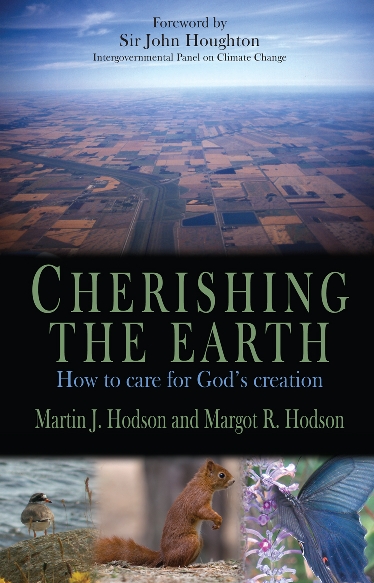
Hodson, M. J. and Hodson, M. R. (2008) Cherishing the Earth, How to care for God’s Creation, Oxford: Monarch.
Weaver, J. and Hodson, M.R. Eds. (2007) The Place of Environmental Theology: a guide for seminaries, colleges and universities, Oxford: Whitley Trust, and Prague: IBTS.
Hodson, M.R. (2007) ‘Creative harmony: Isaiah’s vision of a sustainable future’, in R. J. Berry, Ed. When Enough is Enough, A Christian Framework for Environmental Sustainability, Leicester: IVP, pp. 169-177.
Hodson, M.R. (2004) Environmental Christianity: insights from our Jewish Heritage, JRI Briefing Papers, No. 13, Cheltenham: The John Ray Initiative.
Hodson, M.R. (2000) A Feast of Seasons, Celebrate the Bible's festivals with your family and friends, London: Monarch.
Hodson, M.R. (1998) Jerusalem’s Story: A Series of Bible Studies for Individuals or Groups, St Albans: Olive Press.

Media

Premier Radio (2017) Climate change and us, hosted by Martyn Eden, 11 May 2017
Hodson, M. R. (2015) Hope for the world: The Journey from Paris to Bethlehem, A Rocha, Advent Calendar, door 13: http://advent.arocha.org.uk/
BBC, Radio 4 (2007) Held together in Christ, a Christian response to Climate Change, Live broadcast for 8.10am Radio 4 Sunday Morning Worship, from the Chapel of Jesus College Oxford, led by the Revd Margot Hodson, with Sir John Houghton and the Choir and students of Jesus College, 11 February 2007.


Tuesday, 8 October 2013

Don't Stop Thinking About Tomorrow

From one IPCC report to the next, a personal reflection

Back in February 2007 on the day that the physical science section of the 4th IPCC report came out I was teaching environmental ethics at Oxford Brookes University. My wife, Margot, was then Chaplain of  Jesus College, Oxford. She had been asked by the BBC to take a special service to coincide with the publication of the 4th report for BBC Sunday Worship on Radio 4. The theme was "Creation held together in Christ" and the preacher was Sir John Houghton. We all gathered early Sunday morning in the Jesus College Chapel. The choir were amazing, with wonderful hymns, and the message was crystal clear. We even had a special recording from Rev Rich Cizik, then Vice-President of the National Association of Evangelicals, and a tireless worker in the churches in the United States for action on climate change. Margot had bags of appreciative post after the service. We wrote up this story and the background to it in our 2008 book "Cherishing the Earth." The 4th IPCC report made it very clear that we had a lot to do, and that the time available was short.

Hope for Planet Earth team 2008. Sir John Houghton is to the left of the poster and I am on the far right
I had been fairly active on climate change before the 4th IPCC report, but I don't think I had quite envisaged how much the topic would dominate my next few years. In the summer of 2007, I became involved in the planning for a large UK wide tour on climate change aimed partly at Christian audiences. The consortium behind the "Hope for Planet Earth" tour was the John Ray Initiative (JRI), A Rocha UK, Tearfund and Share Jesus International (SJI). In the end I became the tour scientist, and put together the science section of the overall presentation with Sir John. In February and March of 2008 we spent four weeks on the road around England with schools presentations in the day and church groups in the evenings. It was exhausting, but very worthwhile. We repeated the whole thing again early in 2009, and by the end I had clocked up around a hundred climate change presentations over the two years.
It turned out that 2009 was a significant year for us as Margot began a new job in charge of the Haddenham benefice in Buckinghamshire. We soon found ourselves involved in the local Transition group, and I answered the questions after several showings of "The Age of Stupid" the climate change documentary drama film. Late in 2009 activity on climate change ramped up in all sorts of ways. We saw "Climategate" come and go, we went on "The Wave" climate change march in London. And then there was the huge disappointment that was Copenhagen United Nations climate change meeting. It is fair to say that before Copenhagen many environmentalists were hopeful that we could "solve" the climate change problem, and that afterwards hope tended to evaporate.
Some things happen by chance, or maybe you could say God plans them rather well. In the autumn of 2010, Margot attended the "Society for the Study of Christian Ethics" meeting in Cambridge, which was on the theme of "Climate Change". She got talking with Ruth Valerio of A Rocha UK. Both had been theological speakers on the "Hope for Planet Earth" tours and elsewhere. They often follow scientists like myself with the idea of providing "Christian hope" after the rather dour environmental message. As time had gone on, and particularly following Copenhagen, that hope had become less proximate and more eschatological. In other words it had changed from "we can fix it" to "it will all work out OK in the end". So hope was running a little thin. Thus began the "Environment and Hope" project which filled a lot of my time from 2011 to 2013. The first thing Ruth and Margot did was to gather a small meeting of theologians, scientists and activists in Oxford in October 2011 to thrash out some ideas. I did a short talk on the present environmental situation to stimulate the thinking. After that we decided to go for a bigger meeting at High Leigh Conference Centre in May 2012. There we had 60 people, many of whom are involved in communicating the news about climate change and other environmental problems to Christian audiences. Again I did a talk, and this time I was joined by the theologian, Richard Bauckham, and Andy Atkins, Executive Director of Friends of the Earth in the UK. We really felt that we needed to publish all this material, and it was Richard Bauckham who suggested that it could go into a special issue of Anvil, the theological journal.
We had deliberately kept the "Environment and Hope" project broad in its remit. So climate change was in there, but it was not the only environmental issue we covered. However, whilst we were in the middle of the project an opportunity came up to really focus on climate change. Andy Kingston-Smith and his colleagues from Redcliffe College in Gloucester were planning their "Carnival Kingdom" book and they asked us to look at "Climate Justice". So quite a lot of the summer of 2012 went on that. I covered the science, the policy and the action, and Margot contributed some theology. The book appeared in early 2013. Almost as soon as I had finished "Climate Justice" I moved on to helping Margot, who was guest editor of the Anvil edition, get it all together. We just made the deadline, getting it in on 31st December 2012 in time to go to a New Year party! But then Anvil hit some delays. We did some updating in the summer of 2013 though, and the whole volume went live on 5th September 2013 around three years after Ruth and Margot kicked off the whole process. Crucially it was out in time for the release of the 5th IPCC report.
On Monday 23rd September 2013 the scientists from the IPCC gathered in Stockholm to deliberate on the final version of the Physical Science component of the 5th report. Meanwhile on the evening of the same day we were holding a rather different gathering, the official launch of the "Environment and Hope" issue of Anvil, at Ripon College Cuddesdon, nr. Oxford. We knew that the summary for policy makers for the 5th report would come out on the following Friday. Where were we on that Friday? Well six months before I had booked to see Fleetwood Mac at the O2 stadium in London. Rather a different musical style to that in Jesus College Chapel at the time of the 4th report in 2007! It was a brilliant, brilliant concert. The highlight for me, and for many others, was the appearance of Christine McVie to play with her former band, for only the second time in fifteen years (she had also played the previous Wednesday). She only played one song, her famous "Don't Stop". The lyrics of the chorus go like this:
Don't stop, thinking about tomorrow,
Don't stop, it'll soon be here,
It'll be, better than before,
Yesterday's gone, yesterday's gone.


Don't stop, thinking about tomorrow. Throughout Friday 27th I had been picking up the news on my phone about the 5th IPCC report. Once I heard "Don't stop", I just could not get the words out of my mind. I should explain that the song is actually about the breakup of Christine's marriage many years before, but those words, "Don't stop, thinking about tomorrow", just kept nagging at me. It just seemed an incredible thing for me to hear on that particular day. And they are the reason I wrote this blog. The day after the concert we returned home, and my first job was to edit the comments that Sir John had sent me concerning the 5th report and to get them out on the web. And the following Thursday I was in Aylesbury speaking about the 5th IPCC report. I don't think I will stop, well not anytime soon! And I would encourage anyone who reads this to "Don't stop, thinking about tomorrow."

Martin Hodson (8th October 2013)


Sunday, 5 May 2013

Our Publications on Christianity and the Environment

Martin and Margot in Austria
Our Publications on Christianity and the Environment
For the past few years we have been writing and publishing quite a range of publications in the general area of "Christianity and the Environment". From the more academic to the more popular, and from books, booklets, and briefings to Bible studies and even a DVD! We thought it might be useful for people to have one spot which collects them all together and gives some details of how you can obtain each one if you want it (some are not easy to find!). We will arrange the publications by date:

2004
Margot started by linking her former work on the Jewish Roots of Christianity (e.g. A Feast of Seasons) with thinking about the environment:
Margot R. Hodson (2004) Environmental Christianity: insights from our Jewish Heritage. JRI Briefing Papers, No. 13, Cheltenham: The John Ray Initiative.
This briefing can be downloaded from the JRI web site and paper copies can be ordered from the JRI Office. A reasonable level of theological knowledge would be an advantage in reading this briefing.

2007
Margot was asked by Prof. Sam Berry to write a short epilogue article for his latest book:
Margot R. Hodson  (2007) Creative harmony: Isaiah’s vision of a sustainable future. in R. J. Berry, ed. When Enough is Enough, A Christian Framework for Environmental Sustainability. Leicester: IVP. p.169-177.
This book can be purchased from Amazon UK. A reasonable level of theological knowledge would be an advantage in reading this chapter.

In 2006 we both attended an important meeting at the International Baptist Theological Seminary (IBTS) in Prague where the aim was to consider what might go into the syllabus of a Bible College in terms of environmental theology.  John Weaver and Margot edited the resulting volume:
John Weaver and Margot R. Hodson eds. (2007) The Place of Environmental Theology: a guide for seminaries, colleges and universities. Oxford: Whitley Trust, & Prague: IBTS. The book can be downloaded HERE. Within this book Martin wrote a chapter:
Martin J. Hodson (2007) Environmental theology courses in Europe- Where are we now? in John Weaver and Margot R. Hodson eds. The Place of Environmental Theology: a guide for seminaries, colleges and universities. Oxford: Whitley Trust, & Prague: IBTS. pp. 107-120. Download HERE.
The book can be ordered from the JRI Office. The book is at a fairly academic level and would not be recommended for the general reader.

2008
The pinnacle of our work so far in this whole area. Many years brewing, but worth it, was our book:
Martin J. Hodson and Margot R. Hodson (2008) Cherishing the Earth. How to care for God’s Creation. Oxford: Monarch.
The book can be ordered from the JRI Office, from Amazon (States) and Amazon UK  Intended for the general Christian reader. We gathered all the reviews we could find onto one page.

2009
Late in 2008 we both spoke at the annual Agricultural Christian Fellowship meeting. Margot gave the following paper which was written up for a Rusource Briefing:
Margot R. Hodson (2009) Theology of the Land. Rusource Briefing 776.
If you would like a copy of Margot's paper Contact Us.

In the spring of 2008 and 2009, Martin went on two national "Hope for Planet Earth" tours of the UK with JRI, A Rocha UK, Tearfund and SJI. We visited schools in the days and churches and Christian groups in the evenings, and covered a total of 35 towns and cities. Martin was the tour scientist and did all of the science presentations on the tours. As a spin-off from the tours we made two DVDs, one intended for churches (with Bible studies and theology) and one intended for schools (with lesson plans and ethics). Martin contributed the section on "The Problem", basically a brief look at the science of climate change.
Martin J. Hodson (2009) The Problem. In Hope for Planet Earth. A Christian Response to Climate Change. A multimedia DVD resource for churches. (eds E. Morrice & F. Moffat). SJI, London.
The DVDs can be ordered from the JRI Office. The Church DVD is intended for the general Christian public, and the schools DVD is aimed at 15/16 years and above.

2010
Margot was asked by the Oxford Centre for Mission Studies (OCMS) to write a chapter on environmental mission for their book on holistic mission:
Margot R. Hodson (2010) Storm clouds and mission: creation care and environmental crisis. in B.E, Woolnough and W. Ma eds. Holistic Mission. God's Plan for God's People. Oxford: Regnum Books International. pp. 212-226.
The book can be purchased from OCMS or downloaded for free HERE. If you would like a copy of Margot's paper Contact Us. Not a difficult read, but intended mostly for those interested in missiology.

2011
Margot studied geography for her first degree, and has has long had an interest in Isaiah. These factors came together in her Grove Booklet:
Margot R. Hodson (2011) Uncovering Isaiah’s Environmental Ethics. Grove Booklet, Ethics series, E161. Cambridge: Grove Publications.
More details about this booklet and how to get a copy can be found HERE. The booklet is set at a fairly high theological level.

Martin and Margot spoke at the big "Faith and the Future of the Countryside" in 2010, and this booklet came out of this work:
Martin J. Hodson and Margot R. Hodson  (2011) Climate Change, Faith and Rural Communities. Agriculture and Theology Project, Northampton.
The booklet can be ordered from the JRI Office or downloaded for free HERE. Not a difficult read, but note that it is very definitely focused on the rural areas of the United Kingdom.

2012
Martin helped supervise Lizzie Rushton's undergraduate thesis and the briefing arose from this work:
Elizabeth A.C. Rushton and Martin J. Hodson (2012) Faith, environmental values and understanding: a case study involving Church of England ordinands. JRI Briefing Papers No. 25, Cheltenham: The John Ray Initiative.
This briefing can be downloaded from the JRI web site and paper copies can be ordered from the JRI Office. This is more like a social science research paper, and has quite a lot of statistical analysis. But you can avoid all that if you wish to get an idea of the overall conclusions! Obviously set in a UK context.

2013
Margot was asked by Bible Reading Fellowship (BRF) to contribute 12 Bible Studies on the Environment and Bible for their booklet covering the early part of 2013:
Margot R. Hodson (2013) Environment and the Bible. in L.Cherrett ed. Guidelines, Bible study for today’s ministry and mission, Vol 29 part 1.
Fortunately, BRF decided to release Margot's studies as a FREE SAMPLE in PDF format. If that does not work Contact Us. These studies are intended as an introductory set  for people who are new to thinking about this area, but could be a valuable resource for anyone.

Our friends from Redcliffe College, Gloucester, UK asked if we would write a chapter for them on Climate Justice, and this was the result:
Martin J. Hodson and Margot R. Hodson (2013) Climate Justice: contemporary developments in science, policy, action and theology. In Carnival Kingdom - biblical justice for global communities. Eds. M. Hoek, J. Ingleby, C. Kingston-Smith, & A. Kingston-Smith. 125-143. Wide Margin Publishers.
Our chapter can be downloaded for free and details of how to order the whole book are HERE.The book is intended for those interested in mission/justice, but our chapter has a useful summary of the science and policy on climate change up to August 2012, which may have wider use.


Margot started a project on "Environment and Hope" with Ruth Valerio in 2010. This led to a small consultation and then a larger conference. After the conference we were approached by Anvil theological journal, who asked if we could produce a special edition on the topic. So in September 2013 the edition we co-edited appeared HERE. This is written at a fairly academic level.
Margot wrote an editorial for the volume: Margot R. Hodson (2013) Discovering a robust hope for life on a fragile planet. Anvil 29(1), 1-6. Free download HERE
Martin also had a paper in the journal looking at our current environmental situation, that was the "setup" paper for the following papers on theology and action: Martin J. Hodson (2013) Losing hope? The environmental crisis today. Anvil 29(1), 7-23. Free download HERE.

2014
Sierra Nevada, Spain
On paper this was not quite as productive as in some previous years, but we had a three month sabbatical from August to October (mostly in Spain and Portugal), and the fruits of that will be apparent in 2015. However, we did produce a few short blog articles which appeared in 2014.
Martin wrote several posts for the John Ray Initiative blog:
1) Genetically Modified Animals HERE
2) Meat, Climate Change and all that HERE
3) Review of "The Collapse of Western Civilization": Naomi Oreskes and Eric M. Conway HERE

Margot was asked by Christian Concern for One World to write an article for them:
Margot R. Hodson (2014) Why I Care about the Environment. Download HERE.

2015
In the last few years there has been a growing campaign suggesting that institutions should get rid of their investments in fossil fuels. This started in the States, but has spread worldwide. Many churches and denominations have divested, but some have still to decide (notably the Church of England). Operation Noah have led the campaign in the United Kingdom for churches to divest. We were very pleased to be asked to contribute a short article on the ethics of divestment to join a distinguished group of authors looking at this topic. Links to the articles coming out of this can be found HERE. Our own article is: Martin J. Hodson and Margot R. Hodson (2015) Is it ethical to invest in fossil fuels? How can environmental ethics inform our decision making? HERE


Margot was asked to write an article for Preach Magazine which was producing a special edition on "Preaching for the Planet" in Spring 2015. The whole magazine is HERE.
Margot's contribution is: Margot R. Hodson (2015) Preaching for the planet- key Bible passages. Preach Magazine (Spring 2015), 20-24. HERE

Martin was asked to review Michael Northcott's "A Political Theology of Climate Change" for Anvil Journal (March 2015), and the result is on p. 76 of the book reviews section. HERE

We had been working on the whole area of climate scepticism really since the Copenhagen climate change conference in 2009. But we finally managed to finish off the work on our 2014 sabbatical and here it is:
Martin J. Hodson and Margot R. Hodson (2015) The Ethics of Climatic Scepticism. Grove Books Ltd., Cambridge.
Details of the contents, where you can purchase a copy, and the formats that it is available in are HERE.

Coming in September 2015: "A Christian Guide to Environmental Issues".


Saturday, 23 March 2013

Carnival Kingdom

Carnival Kingdom - biblical justice for global communities
Edited by Marijke Hoek, Jonathan Ingleby, 
Carol Kingston-Smith, and Andy Kingston-Smith.
We were pleased to contribute the Climate Justice chapter to this (2013) book:
HODSON, M.J. & HODSON, M.R. (2013) Climate Justice: contemporary developments in science, policy, action and theology. In Carnival Kingdom - biblical justice for global communities. Eds. M. Hoek, J. Ingleby, C. Kingston-Smith, & A. Kingston-Smith. 125-143. Wide Margin Publishers.

For more details go to Carnival Kingdom